

Colour Mutations

Standard Grey
The origional colour of wild Chinchillas, though it can vary in shade from a light grey to extra dark. A Standard chins belly is always white, with the darkest colouration along its back and head.
Standard grey is a gene that is ressessive against Beige, White and Velvet, but dominant against most other colour mutations. If a chin has a single standard gene and a recessive colour gene it is a carrier and can still pass on those recessive genes.
Beige
The 'Tower Beige' is classed as a dominant gene, meaning that if one parent passes on the gene the offspring is most likely to express that colour. More accurately though it is an 'incomplete dominant gene' as other homo-recessive genes can show through. A 'Hetrero Beige' is a chin that has only one Beige gene, meaning they carry another colour gene, often ebony or standard. A 'Homo Beige' is a chin that carries two of the gene. Both present with red eyes, some darker than others, so the only way to tell the difference without knowing the animals parantage is to look at their eyes in indirect sunlight, as Homo-Beige chins typically have a bluish colour tint that circles the pupil.

Brown Velvet

'Velvet' or 'TOV' (touch of velvet) is a recessive colour pattern. It doesn't change the animals colour, but does affect how the colour is distributed. It causes a darker veiling of colour over the back and head of a chin, and a more distinct seperation of the back and belly colours rather than a gradual fade. A Brown Velvet typically refers to a Beige chinchilla with the Velvet gene. It is important to note that the Velvet gene cannot exist in a Homozygous state and embreyos produced with two of the gene are either reabsorbed by the mother, or born weak and sickly.
Tan
The 'Tan' colour isn't a distinct gene in iteself, but is instead a colour created by crossing the Beige and Ebony genes. Sometimes referred to as a 'Beige Wrap', the colouring typically wraps fully around the body in a more uniform veiling rather than having a white belly and darker back. Tan chinchillas can come in shades varying from very pale, to a dark 'chocolate brown', and can either have very pale red eyes, or brown eyes.

Ebony
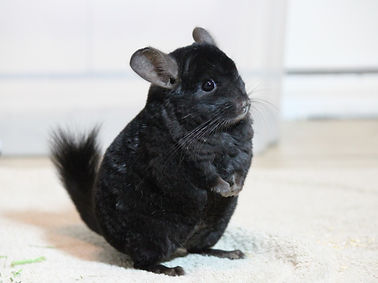
Often referred to as a 'weakly dominant' or an 'incomplete recessive' gene but is more accurately a 'cumulative inheritence' gene as it is weak unless accumulated through multiple generations. It darkens the 'base' colouration of the chin and creates the same wrap around affect of colour seen in TOV chins and so the light and medium variations of this colour are sometimes referred to as Ebony TOV. The colour darkens as more of the gene is introduced and inherited until you arrive at the 'Extra Dark Ebony'.
Ebony TOV vs Gunning Black
The 'Gunning Black Velvet,’ ‘Black Velvet,’ or ‘Black’ Chinchilla is not the same as an Ebony TOV, but is sometimes mistakenly referred to as such. The 'Black Velvet' is a heterozygous-only dominant gene and is lethal in a homozygous form. Comparred to an Ebony TOV (left) which typically has a grey or darker belly, a Black Velvet (right) should have a bright white belly. They are saught after in the industry because of their colour and size, but are hard to breed and often have fewer births.

Black Pearl

One of the newest colour mutations, the Black Pearl gene is entirely different from both the Ebony and Gunning Black genes and is fully resessive, meaning both parents need to pass the gene on to produce a Black Pearl. Unlike the other Ebony/Black colourations the Black Pearl has an extra dark, solid black colour across it's body with no variation, a bright white belly, and a distinct seperation of the two. The colour has only very recently started to become available (albeit difficult to get) in the UK.
White, Silver or Mosaic
The 'Wilson White' is another Dominant Heterozygous gene, and therefore lethal in a Homozygous state. A 'White Mosaic' refers to any colour bred from White and Ebony, that expresses the Ebony gene. It can be identified through their darker black or grey ear colour. The coat colour and pattern can vary greatly and can be referred to with different names such as 'White' (expressing little to no black), 'Silver' (pictured, an even veiling of black tipped hair), 'White TOV' (carrying the TOV gene) and 'Mosaics' (presenting with black and white patches accross the body).


Pink White
The alternative to the Whites mentioned above, a 'Pink White', also known as a 'Tan White' or 'Beige White', is any varient bred from a White and Beige, that expresses no Ebony. Unlike their Ebony counterparts, these chins have pink ears, and are more likely to have little to no colour, also making Extreme Beige Mosaics much more rare.
It is worth mention that these are not the same as Albino, and typically have darker eyes.
Goldbar
The 'Goldbar' or 'Lowe Recessive White' is a seperate White gene that is fully recessive and requires the gene to be passed down from both parents to express. The result is an almost creamy whitish beige with varying degrees of golden coloration through the fur. They are not commonly available in the UK.


Violet
There are two variations of the 'Violet' genes with their own distinct lineage. The 'Sullivan Violet', which is more widely available but still uncommon, and the 'Dutch Violet', which is rarer outside of Germany. Both are recessive genes that present similarly with a Violet coloured fur and white belly.
Violet Variations
A 'Violet Wrap' or 'Ebony Violet' (pictured), is a colour variation caused by the Violet colour mutation, and the Velvet pattern gene, or, the cumulative Ebony colour mutation. The Violet colouration of the chin wraps fully around the body, though it can still have darker veiling similar to the Ebony chinchillas. And a 'Sullivan Violet' crossed with a 'Black Velvet' can produce a variation known as 'Ultra Violet', which still has a white belly but a darker fur colouration.


Sapphire
A recessive gene that requires a homozygous state to present. The colour shows as a very pale grey with a blue tint, and pink ears.
Blue Diamond
The 'Blue Diamond' is a double recessive hybrid, created by crossing a Violet and Sapphire. They present with a pale, dusty blue or lilac coat colour and white belly. Due to their rarity and the difficulty in producing them from double recessive genes they are highly saught after and much more expensive.


Royal Persian Angora
A 'Royal Persian Angora', otherwise known as RPA, is a long-furred chinchilla. the RPA gene is not quite a true recessive, with some carriers (RPAC) presenting with slightly longer fur than the typical chinchilla. In it's homozygous state it produces a true long-fur. Like the Velvet gene the RPA can be paired with any colour mutation, but is still only more recently being bred in the UK.
Locken
'Locken' is the name for chinchillas with curly or Rex style fur that is linked to the Ebony gene and can only be produced by Ebony carriers.
In itself it is almost the newest fur mutation, except that it has recently been cross bred with RPA's, creating the 'Royal Imperial Persian Angora'.
