
Housing Your Chinchilla
Cage
Many 'chinchilla cages' sold in pet shops are not well suited to the animal, they tend to be long and low and much smaller than ideal. Try to find the largest cage you can and aim for height instead of floor space. Chinchillas are rock hoppers by nature, they don't climb well but they can leap from perch to perch with ease.
Metal wire cages are best. Glass tanks are not well enough ventilated for chins and wooden hutches will be chewed through. Plastic is unsafe and not secure enough for an animal that will nibble on anything.
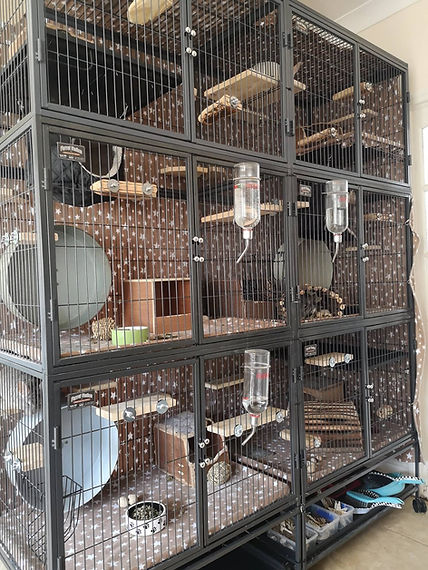
My personal preference is for the 'midwest critter nation' or 'ferret nation' double cages as they are sturdy, long lasting, and can be stacked with an additional cage to create even more space. There are many cages in a similar style by different brands such as the 'liberta explorer' or 'cozy pet RC03' with differing prices so have a look around for something that suits your budget without compromising on space. Alternatively I have found that many parrot cages can be well suited for chins!
The downside to having tall cages is that they are not suitable for kits. If you plan to breed chinchillas a seperate 'nursery' cage will need to be set up, for this a 'thatchers chinchilla cage' with square wire mesh is more ideal, but only for the short term.


Location and Environment
Chinchillas prefer a cool and low humid environment, they struggle with temperatures over 22 degrees celsius. Air conditioning is perfect but not many homes in the UK have it so a fan that isn't pointed directly at the cage can be used in a pinch if you live in a warm area. You can also get 'marble slabs' that are ideal for keeping chins cool, they can be placed in the fridge overnight and then left in a shaded area of the cage for your pet to lay on.
Chinchilla cages should be placed somewhere where the animal will not overheat but without a direct draft. In front of windows is not ideal as the sun can be too hot and shadows from birds or other animals can upset the chins and make them nervous. Don't place the cage near a radiator unless you plan to keep it off all winter.
Preferably keep your cage off of the floor as the higher a chinchilla is the more safe they will feel, most parrot style cages come with a stand that suits this well but using a table or unit works too. Choose an area of your home that is not too busy to avoid unnecessary stress, but where you will still often pass through and be seen as this will help keep your pet used to having people around. If they are kept in a room where you don't go very often you will need to spend more time socialising every day.
If your cage is placed against a wall I would recommend putting something behind it to protect your house. A thin blanket or towel is a cheap option but it will need washing and eventually it will get chewed. Make sure that any furniture, wires or plants are kept a safe distance from the cage bars, chins have a surprising reach when they want something.
Furniture
Ledges and shelves are the number one cage item on your must buy list. They come in all different shapes and sizes and can be moved around to create an enriching environment, wooden ones will be chewed and occasionally need replacing. I would suggest that if you have a new chin you place levels close together and low down until your pet is confident and then spread them further up the cage. I tend to rearrange my ledges at least once a month and sometimes spread them very far apart to encourage exercise. Ladders and slopes often come with cages but I have found they don't benefit the animals and if they are open spaced chins sometimes catch legs between the bars whilst running which can cause breaks.
A hide box is a must have item. Ideally you want one hide per chinchilla, even though they will share most of the time. This will ensure that there is no competition or spats over the best sleeping area. You can buy wooden hides that are loose on the bottom of the cage or ones that can be attached higher up, I like to have a mix of both. Soft beds or hammocks can be used and the chins will love them, but don't expect them to last very long as they will be chewed and peed on.
Many parrot cages come with metal feeding bowls that can be attached to the wire, these are great as they can be removed to clean but are otherwise fixed in place. If you don't have an attached bowl then make sure to get a heavy dish that can't be knocked over.


Substrate
Cages with a wire base and sliding tray underneath are often much easier to clean, reduce mess being thrown out of the cage, and can decrease the chance of many health issues from injesting unsafe, dirty or dusty substrates. You can use woodchip/shavings or newspaper if your chin is not in direct contact with them, but you have to make sure to place some low ledges or a hide box so that your chin doesn't hurt it's feet on the wire by jumping down from height.
If the cage has a solid base you can use fleece liners instead of substrate which can be washed and replaced on a rotation. I find it easiest to give the cages a quick sweep clean with a dustpan and brush before removing liners to throw through the wash.
It is recomended you avoid using woodchip/shaving for direct contact as the wood dust from it causes buildup in the animals lungs which will eventually cause very poor health and often a premature death. A safer alternative is a recycled paper animal bedding called 'back to nature' which I often use along with the fleece for nest boxes and just a bit of extra absorbancy/texture.